A Straight Shot?
Ah, the seasons: the final boss of any sailing trip, and one with a habit of appearing just as you have decided there is surely plenty of time.
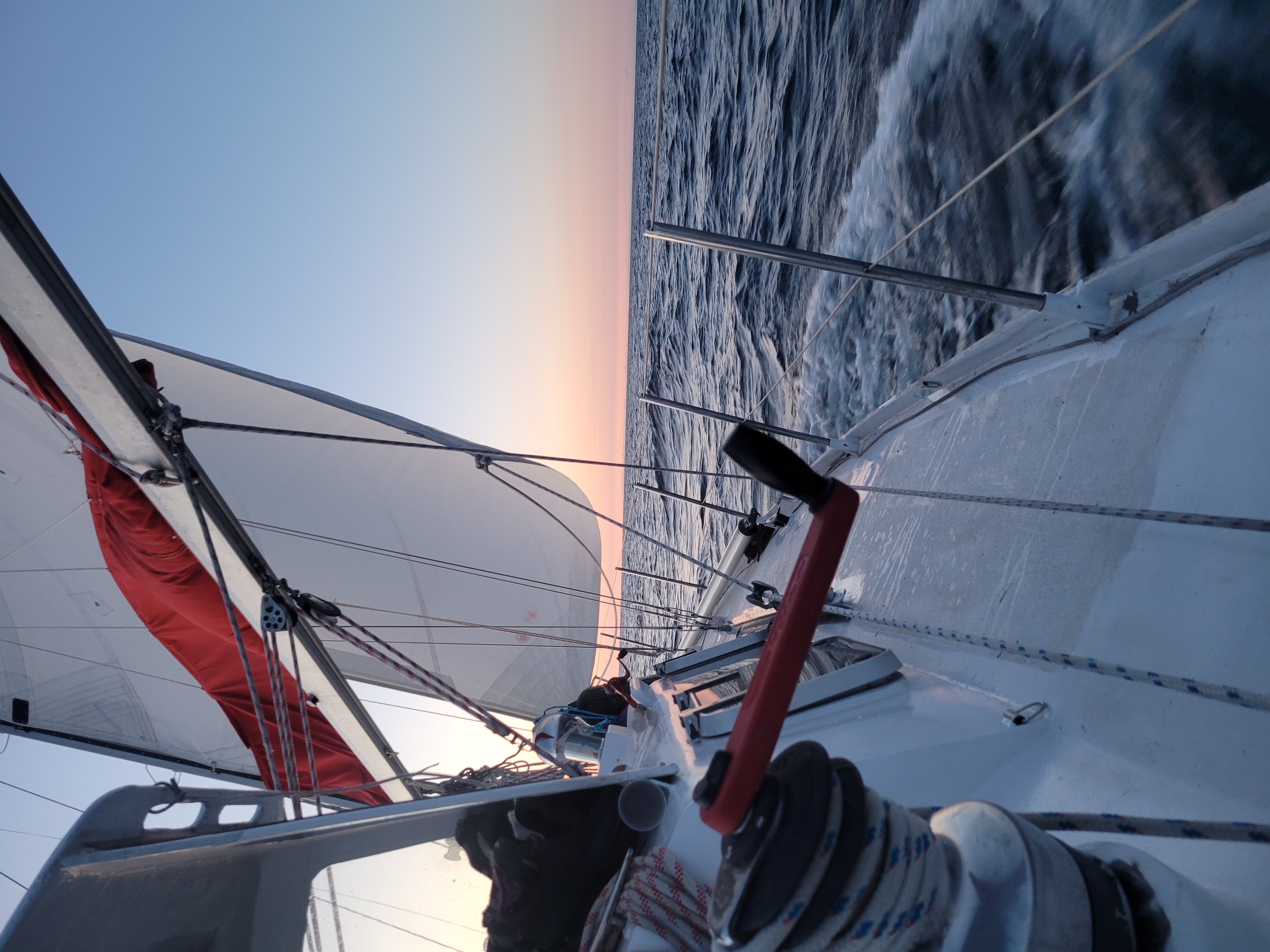 We had finally come to terms with our earlier lollygagging and accepted that, if we intended to get anywhere before winter began making decisions on our behalf, we needed to put some miles behind us. So when a handsome weather window appeared after a few days in St. Pierre, we took it.
St. Pierre is scenic, interesting, and unmistakably French in the way it goes about its business, despite being inconveniently for France attached to the coast of Newfoundland. But there comes a point in any stop when you realize you have seen the principal sights, eaten the available pastries, and walked the waterfront enough times to recognize the local dogs. There is always something you miss while cruising, of course. You cannot stay indefinitely in every pleasant place just in case it turns out to contain a hidden bakery, a remote waterfall, or a shop selling exactly the fitting you have spent three months trying to locate.
So, when the weather arrived, we were ready.
SV Whalie Bird was also ready, with broadly the same plan. Naturally, we left at the same time. This was partly because we were rafted alongside them and therefore could not leave independently without first conducting a small marine extraction operation, but also because sailors have a powerful instinct to depart in company and then spend the next several days pretending there is no race underway.
We set off around the Avalon Peninsula toward St. John’s, the capital of Newfoundland and Labrador and Newfoundland’s largest city—a distinction which is less an indication of metropolitan sprawl than proof that somebody had to be first.
The Trip
We slipped away at 04:30, while the sky was beginning to lighten but the sun was still below the horizon, presumably having a lie-in somewhere to the east. We motored out through St. Pierre’s double-layer breakwater, which had the pleasingly serious air of a place built by people who had met the North Atlantic before and did not wish to meet it again unnecessarily. Once clear of the town and the nearby islets, we raised the main and turned due east.
The forecast had arranged itself in a most agreeable way: westerlies for the first two days, followed by southerlies for the final day. We had two days of east to make, then one day north. It was, on paper, almost too neat. The weather was cooperating so efficiently that we waited for it to produce an invoice.
 At first, we were ahead of Whalie Bird. Then the wind faded as morning became afternoon, and Whalie Bird motored for longer than we did. They pulled ahead in the sort of manner that one acknowledges warmly over the radio while privately making notes on their entering of the "cruising class" of the race, one with more engine hours permitted at the expense of time added to your trip at the end ;) We could still follow them on AIS, which is a marvelous invention. It enables you to know, with great precision, that your friends are going slightly faster than you are somewhere over the horizon. We did not actually see them again until St. John’s harbour wall, but their little electronic symbol remained reassuringly present, progressing along the screen in a way that implied competence.
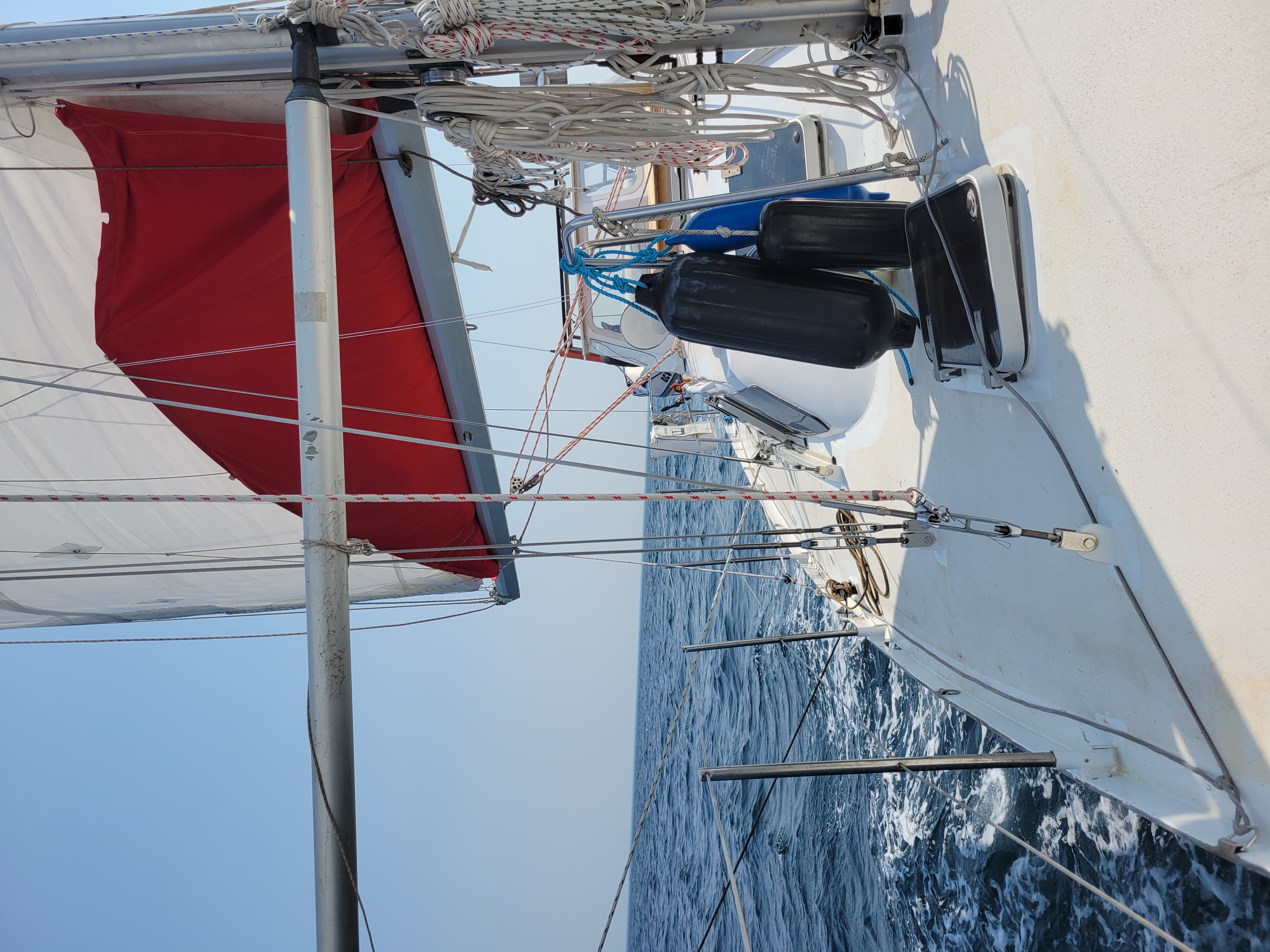
We motored for a spell ourselves, then the wind returned from astern as promised. It was lighter than forecast, but with little swell we moved along beautifully. This was the passage on which the whisker pole finally stopped being a somewhat intimidating aluminium object and became an indispensable member of the crew. We had used it several times before, but here it made an enormous difference, holding the genoa out properly and keeping it from performing its usual impression of a large, expensive bedsheet in a storm drain that it tends to when we are reaching too deeply. It remained up for nearly the entire trip.
Overnight, the wind shifted and filled from behind again as we made the slow rounding toward the north. Even with the Atlantic swell rolling through, the whisker pole kept the genoa firmly where it belonged. Karma flew along as though on rails. The motion was wonderfully smooth, and the autopilot barely had to do a thing.
As we approached St. John’s, warm winds came off the land and whales appeared in the distance. By afternoon, the air had turned gusty, much as it had during our arrival in Halifax. Tall cliffs rose around us, and warm breeze poured down from the land in unpredictable gusts, laying Karma over just as we were taking reefs and trying to look casual about it. It was a fine arrival: whales offshore, cliffs all around, and enough wind to ensure that every person aboard needed something urgent to hold onto.
Arriving
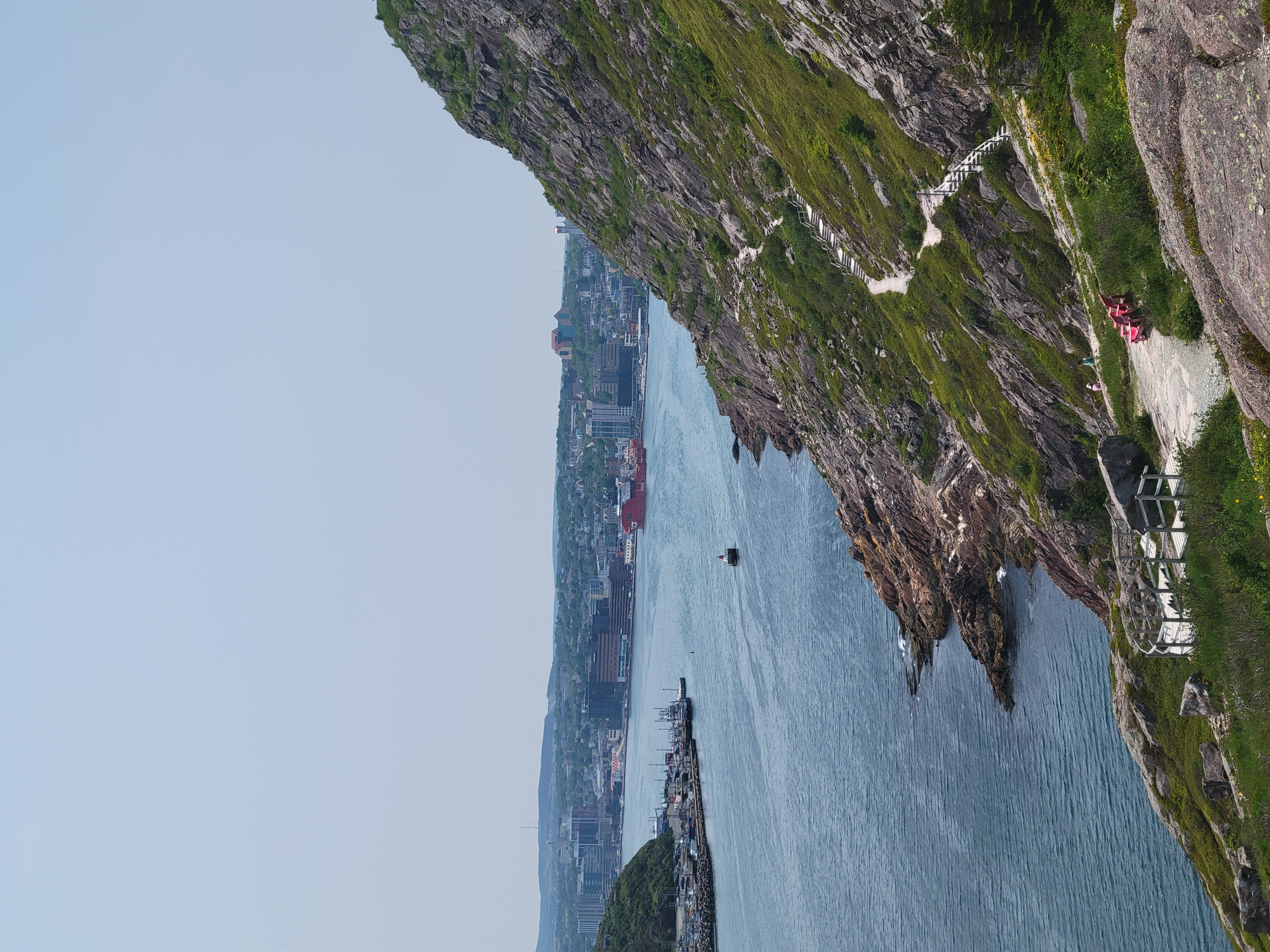
We had been to St. John’s before, though not aboard our own boat, and it felt immediately familiar as we closed in on the narrow harbour entrance. It is a remarkably scenic approach. Signal Hill rises to starboard, high and rather grandly overqualified for its role as a harbour-side landmark. Bright houses cling to the slopes on either side, and then, through the Narrows, the bay opens out into St. John’s itself.
 We tied up alongside “the wall,” as it is known locally. St. John’s has no conventional yacht marina, which means visiting boats either anchor or tie alongside concrete, generally in the same sort of stout, practical locations used by working vessels and tugs. We went against enormous tires, which were reassuringly large and looked capable of absorbing impact from a moderate ship, a wayward whale, or perhaps a disappointed iceberg.
Alongside us were Whalie Bird, Boreas, and two other yachts we had not yet met. This is one of the dependable pleasures of cruising: you arrive in a place where you know no one, then discover half a floating neighbourhood tied to the same slab of concrete.
Customs
Because we were technically arriving from France we were to do the Canadian formalities once again. Whalie Bird had already called ahead, and the customs officers were waiting on the dock when we arrived. They even helped with the lines, which is not a standard feature of international border administration but was very welcome all the same.
Once we were tied up, the process was impressively relaxed. There were questions, forms, and the usual indication that everyone involved regarded the whole affair as perfectly normal. Then came the real surprise: they stamped our passports using a brand-new stamp. Apparently, they do not usually stamp them.
This meant that we had received one of the great small prizes of travel: official documentary evidence that we had gone somewhere slightly unusual. A passport stamp is a deeply satisfying thing, especially when it has been applied by someone who appears pleased to have finally found a reason to use the stamp. Interestingly enough, as I am editing this blog 3 days into crossing the Bay of Biscay for Spain, 5 countries later, this is still the last stamp in my passport
Exploring St. John’s Again
By evening it was getting dark, and Whalie Bird had sort of technically beat us, they had a dinner planned aboard. Homemade pizzas on tortillas: a classic boat meal of theirs which made for a fun dinner which lasted well into the night.
The next day presented a difficult choice: boat projects or town exploring. Boat projects are the permanent background hum of cruising. No matter what has been repaired, improved, adjusted, replaced, or carefully ignored, there is always another job waiting. Usually it is a job that requires a part obtainable only from a chandlery in a city you passed three weeks ago. Then there are the consumables; however diesel was awkward to arrange. Propane was nowhere to be found. Water was also not straightforward, though we were full anyway. These were useful discoveries in the sense that they ruled out doing anything useful.
But St. John’s was warm, and the boat did not appear to be actively sinking, so we chose town exploring.
Signal Hill Hike
We had climbed Signal Hill once before, in 2024 aboard Sea Dragon, on a cold morning when we went up by road to see the place where the first transatlantic wireless signal was received. Whilst we were leaving, looking back toward the harbour entrance we noticed the trails running along the steep cliffs and so this time we decided that climbing the hill the scenic way was preferable to simply marching up the road again.
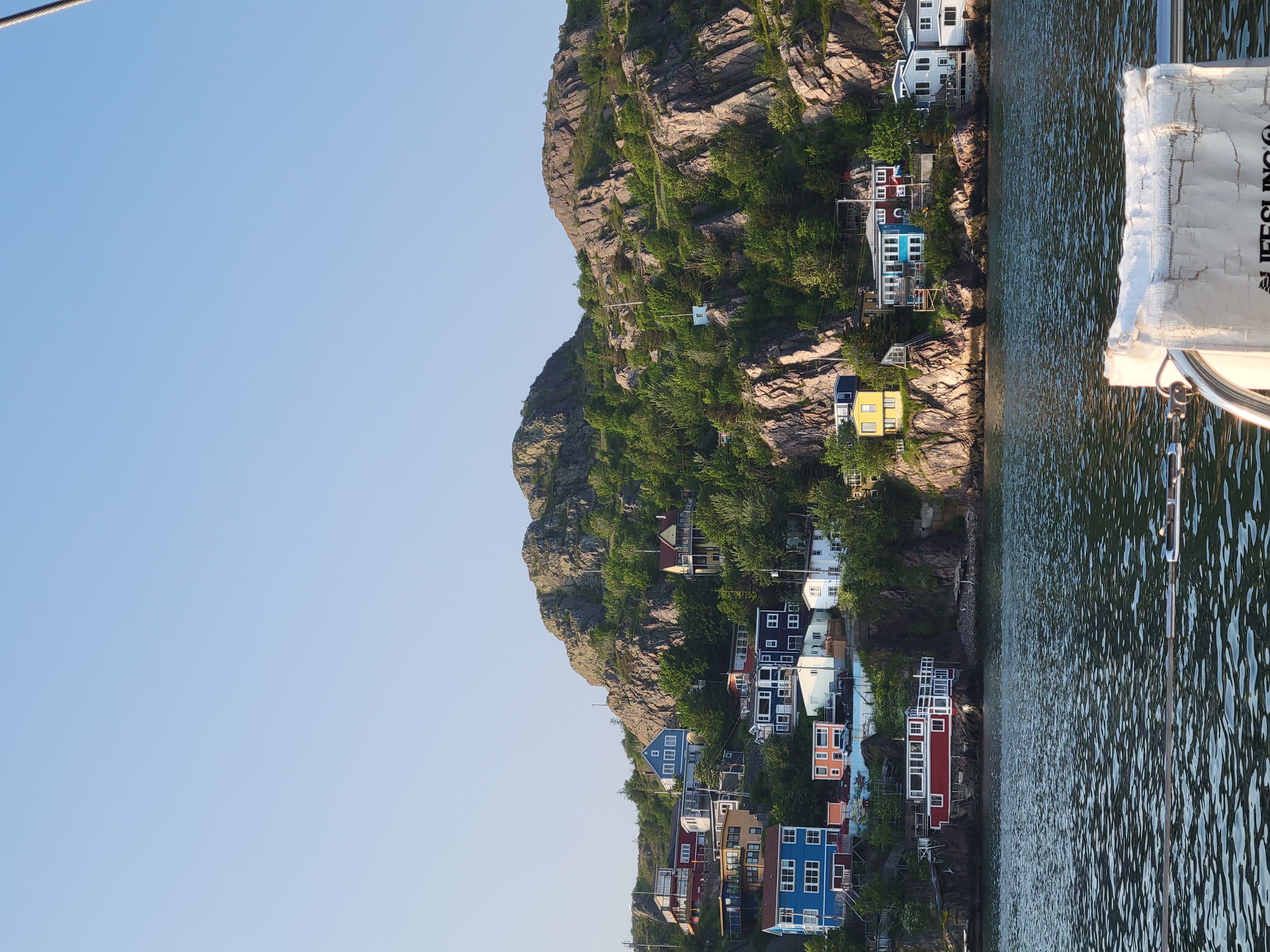
 The Battery neighbourhood climbs the cliff in layers. Houses seem to have been stacked on top of one another wherever a reasonably flat piece of ground could be identified, and the narrow roads twist about with alarming signs warning drivers that, after certain points, turning around may no longer be an available lifestyle choice. At the end of the road, the trail begins.
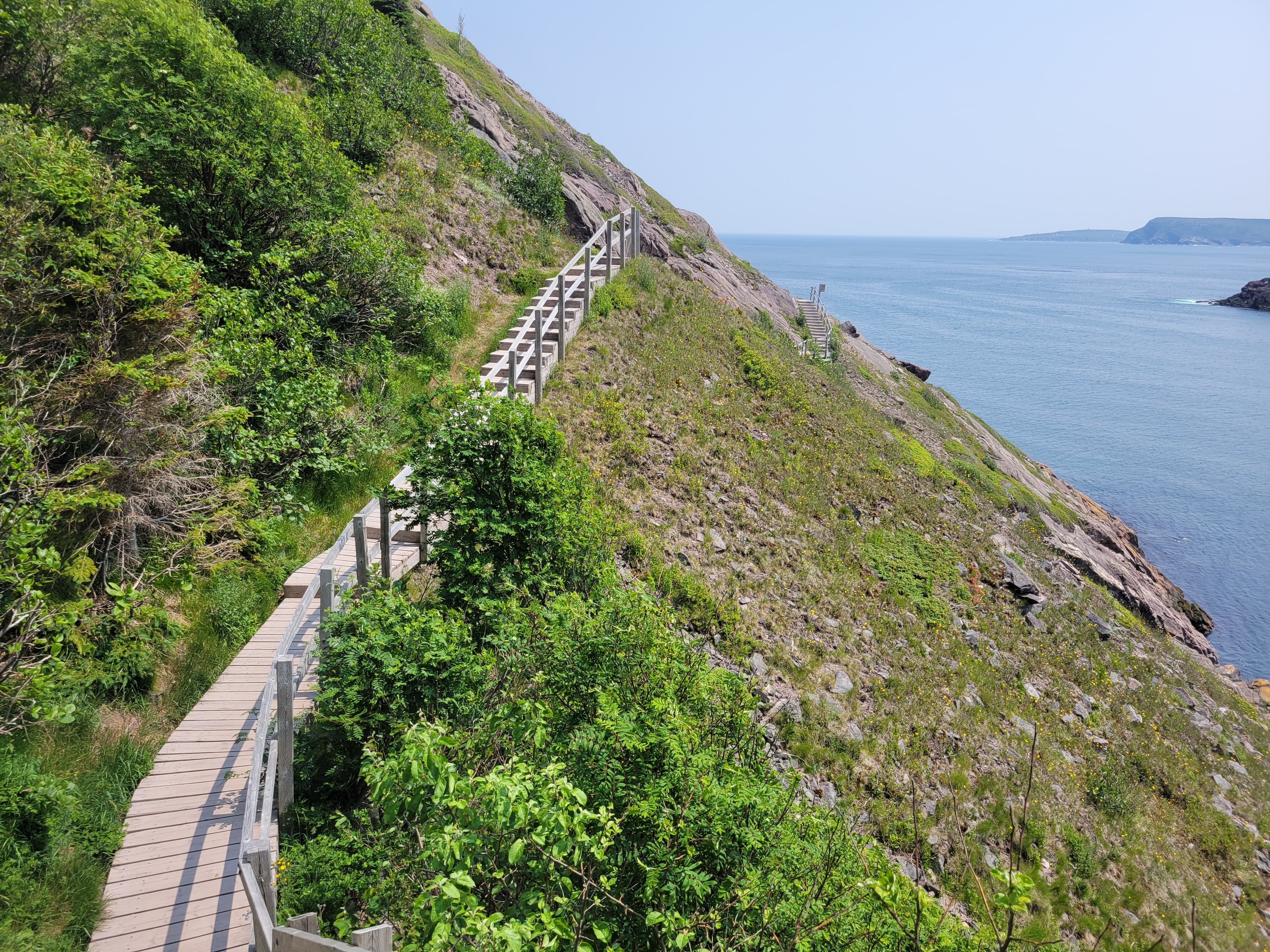
 The North Head Trail follows the harbour entrance and may have been used as far back as the 1500s, which means it has been making people puff uphill for several centuries. It begins only a few hundred feet above the water, then works its way along the cliffs before climbing back and forth toward Cabot Tower. In summer, the waters below can offer whales, icebergs, and seabirds, which feels like an unfair concentration of wildlife considering the effort required to look down at them without falling over. https://parks.canada.ca/lhn-nhs/nl/signalhill/activ/ran-hik
Signal Hill has spent centuries doing the sort of jobs that require a good view and a willingness to be battered by weather. Its strategic position made it central to the defence of St. John’s from the 1600s through the Second World War, and it was used for military signalling from 1704 onward. https://parks.canada.ca/lhn-nhs/nl/signalhill/culture/histoire-history
In 1762, it was the site of the final battle of the Seven Years’ War in North America. A British force led by Lieutenant Colonel William Amherst recaptured St. John’s from the French, who surrendered a few days later. It is hard not to feel that the hill has had a somewhat overactive career: lookout post, battlefield, defensive position, harbour signal station, and eventually an important communications site. Most hills are content to provide a view and perhaps a bench. Signal Hill apparently needed a résumé. https://parks.canada.ca/lhn-nhs/nl/signalhill/culture/histoire-history
Cabot Tower itself was built between 1897 and 1900 to commemorate both Queen Victoria’s Diamond Jubilee and the 400th anniversary of John Cabot’s 1497 landfall in Newfoundland. It was then put to the very practical work of flag signalling—because if you have just built a handsome commemorative tower on a windswept hill, it would be wasteful not to use it to communicate with ships. https://parks.canada.ca/lhn-nhs/nl/signalhill/culture/histoire-history
The most famous oddity came in December 1901, when Guglielmo Marconi received the Morse-code letter “S”—three short signals—sent from Cornwall, England, roughly 3,500 kilometres away. The equipment was stationed not in the tower but in a diphtheria hospital on Signal Hill, which is surely one of the less glamorous locations from which to alter the history of global communications. Marconi’s antenna was raised by kite, because apparently the first transatlantic wireless message required not only scientific brilliance but someone prepared to fly a very large kite in a Newfoundland December. https://www.theglobeandmail.com/life/adv/article-signal-hill-a-must-see-attraction-with-a-colourful-history/
The message itself was merely “S.”
It was a crowded and windy day when we reached the top, as it often is. Cabot Tower stood above the harbour looking much as it has in photographs for years—slightly stern, very photogenic, and entirely at home in the wind. Below us, St. John’s spread out beyond the Narrows, while the Atlantic disappeared toward Europe in the other direction.
We descended by the road we had walked up on our previous visit, but paused for a swim at one of the little ponds along the route. Other people and several dogs were already enjoying the warm weather.
City Goals
What does a cruiser do when arriving in a city?
The first answer is frequently: shower.
There were no shower facilities provided at the wall, but we already knew the St. John’s trick. A local gym offered a three-day trial, entirely free, without requiring a membership card. You simply arrived, asked for a trial, signed a few forms, received a towel, and were released into the building like someone who had just been granted temporary citizenship of civilization.
The showers were lovely. There was even a sauna. An hour later, we emerged separately, clean, warm, and entirely certain that no boat projects would be completed that day.
Downtown
Realizing that this might be our last North American city for a few years, we felt it would be prudent to do some proper Canadian city-slicking.
Heather wanted a moose burger. I was hoping for poutine, on the reasonable grounds that poutine is unlikely to become more available the farther one sails toward Greenland. There would also, obviously, need to be a Molson or three.
It was a sunny day, and the main walking street was full of people. The pubs were open, the city was in good spirits, and we had the difficult but pleasant task of selecting somewhere to eat.
We employed the Kate Frazer method of restaurant choice: “just wandering to find a spot.”
This sounds carefree. In practice, it means walking around several blocks repeatedly, studying each menu at least twice, entering a few places with apparent commitment and then backing out after ten seconds, discussing the merits of every option with increasing seriousness, and eventually selecting one of the first places you noticed an hour earlier.
It is a system. It does not save time, but it ensures that the eventual choice feels thoroughly researched.
We found a place, ate well, drank cold beer, and watched people go by in the sunshine. It was a fine last evening in town.
Later, looking over the weather and accepting that St. John’s was not going to solve our diesel, propane, or general consumables problem, we decided to leave the next morning.
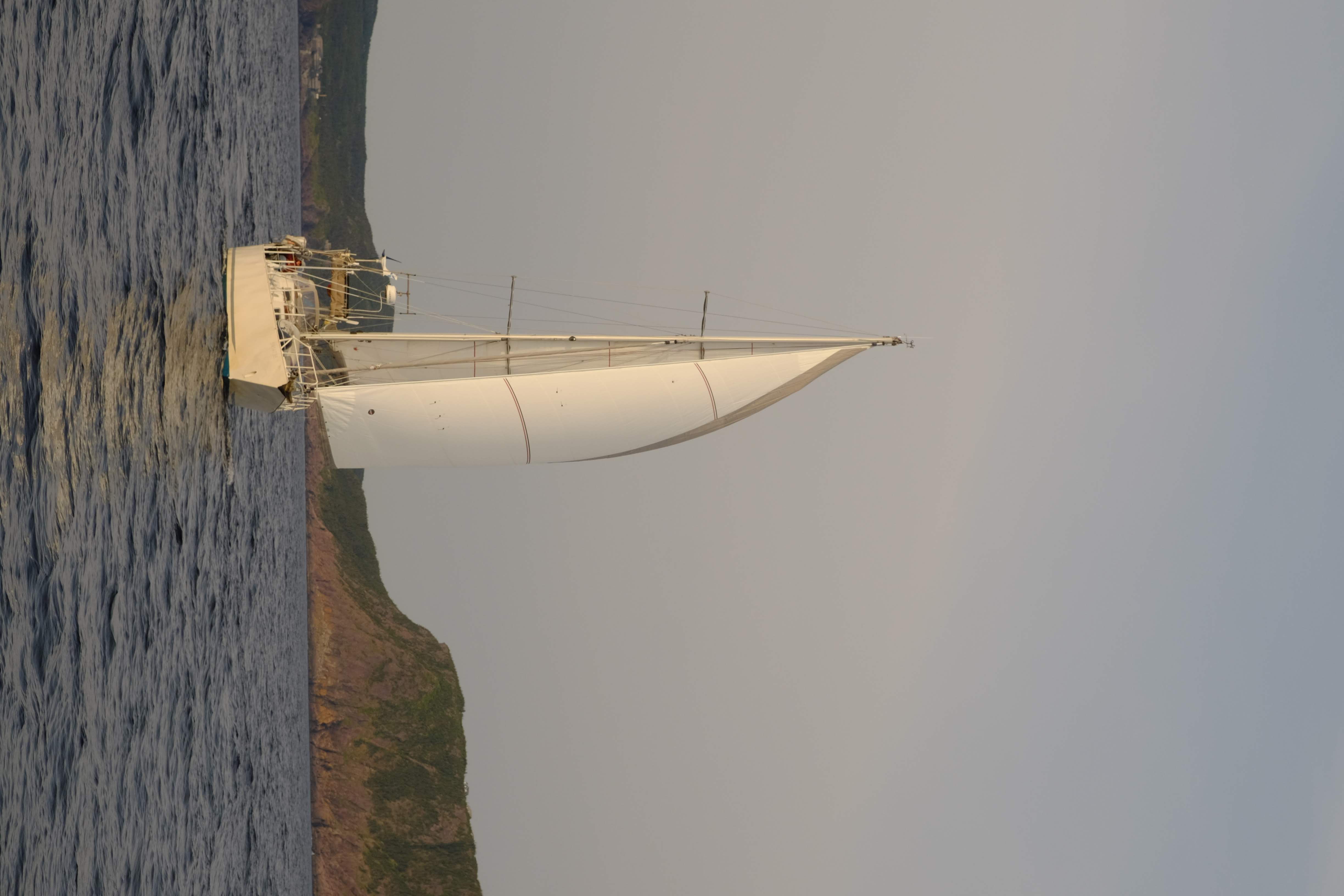 Coincidentally, Whalie Bird was leaving too.