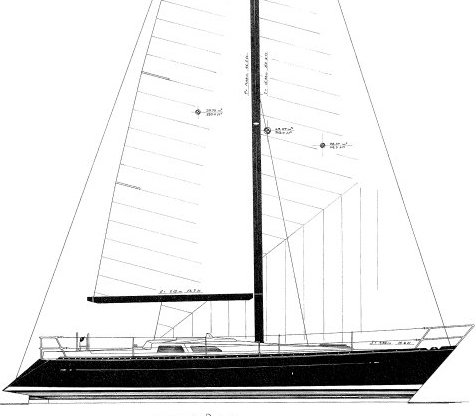
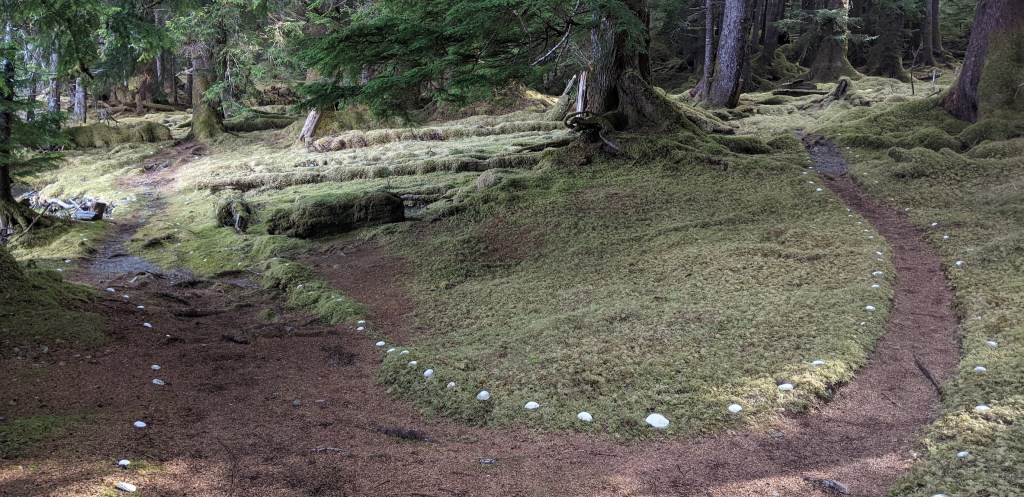
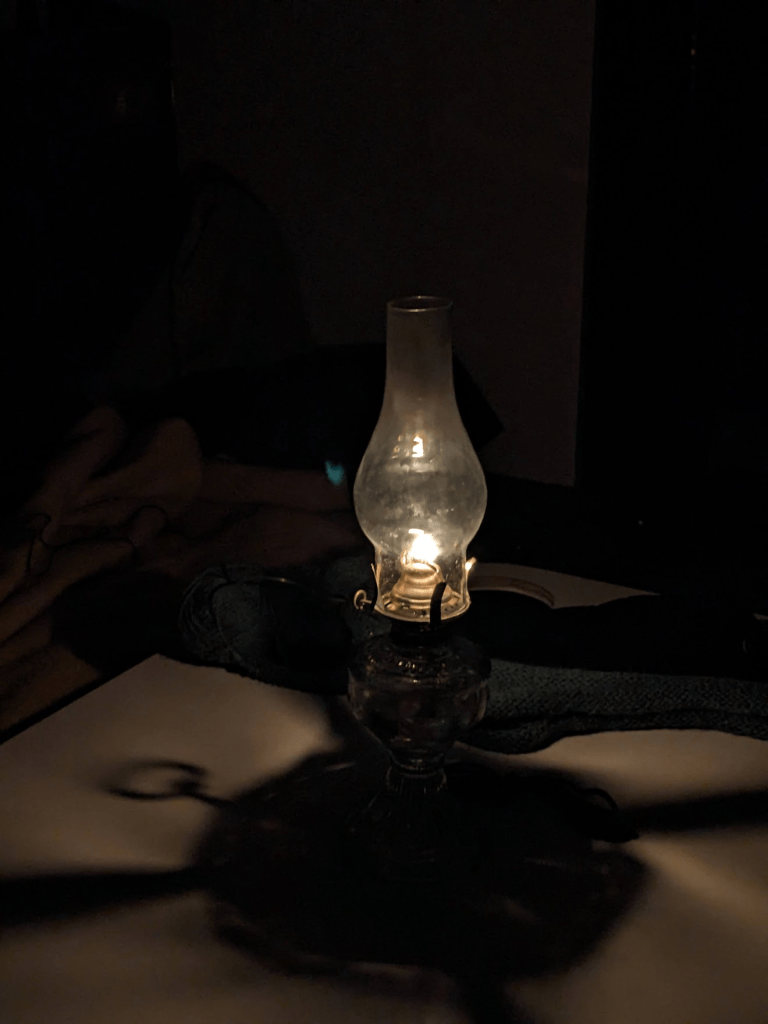
We have ventured to the past! Currently sitting by oil light in a little town called Onset, Massachusettes on our new boat, we decided to catch up our old timeline from the West Coast. We had many adventures around British Columbia, the last blog we did described our time in Daajing Giids. The next few blogs will be about our time in Gwaii Haanas National Park Reserve and Haida Heritage Site and will continue the timeline that makes sense after that. Namely, our trip down the west coast of the states, cruising the Sea of Cortez and mainland Mexico for a few seasons before the purchase of our steel boat, now home, in New Brunswick which we have refit and sailed down to the east coast of the states where we now live and seek jobs! Wooh.
Gwaii Haanas Park is just incredible. Apart from folks like us on their own vessels, there are a handful of tour groups throughout the park traveling by kayak or small boat housing 6 or so people for about a week. We saw maybe 4 other private vessels like ours. The park is welcoming; only a few sites are off limits while everywhere else you are welcome to explore ashore at your leisure. Dense forests, berries to pick, remnants of villages to find, and wildlife galore to watch. The main sites are the 5 “Watchman Sites.” The name finds its origins in the people who stood as look outs for invaders and such. These sites are staffed by Haida folks all summer who reside there off and on, kindly showing visitors around and sharing stories of events and what life like for the Haida who lived there. The Haida names of these sites are followed by the anglicized names in parenthesis. Pronunciations can be found here at Parks Canada.
The first site we visited was K’uuna Llnagaay (Skedans) and we had a most immersive tour with a young lady about our age named Xiila (pronounced “he-lah”). I tried to put what all we learned on paper so what follows are excerpts from my journal/captain’s log. This village once housed 20-30 longhouses.
25 July, 2023
K’uuna Llnagaay
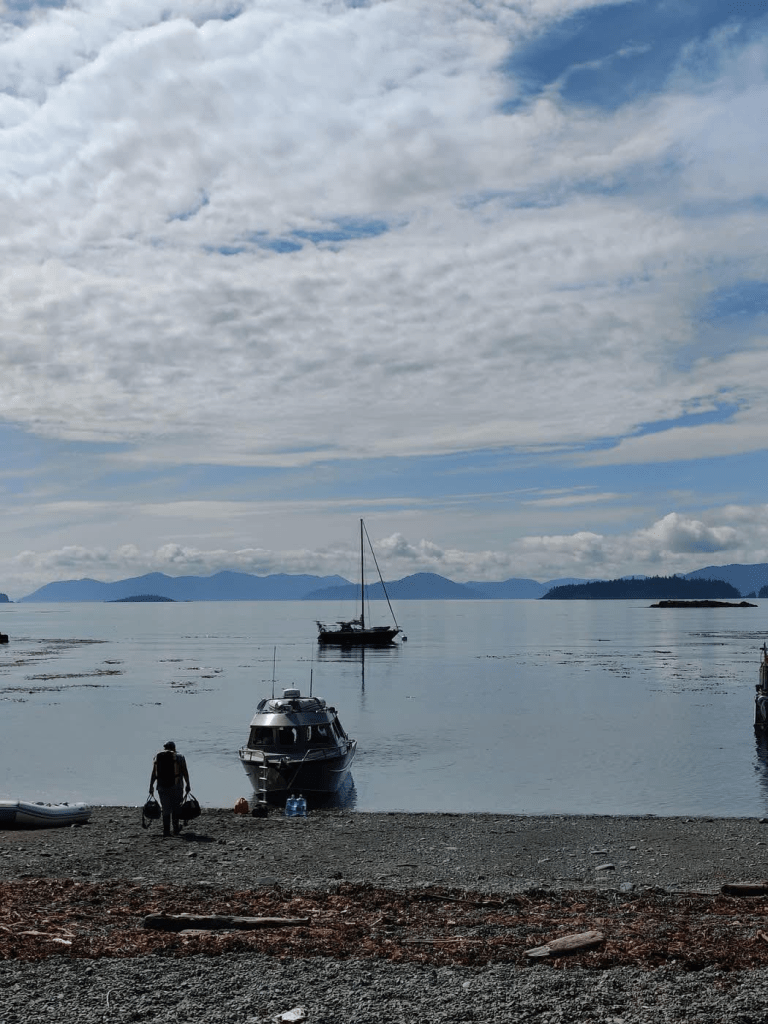
Coffee & hook up by 830 to hit Skedans. Got the 1 mooring ball & headed to shore where Aretha (+son Blake) set us up on a guided tour with her daughter Xiila soon. Haida on both sides – she is part of her mother’s clan. Her dad is Chief of the K’uuna clan (aka Skedans aka an anglicized mispronunciation of the name Gidansda). She told us of her dad’s potlatch to introduce him as Chief & take Gidansda’s name (her uncle, the previous Chief 2016 RIP), the ceremony of his last human walk personified in her cousin’s body, of her 115 years lived great grandmother who lived in a longhouse in K’uuna until she was 5 & how she attended potlatches in Prince Rupert etc, how her dad’s presence in a room of his aunties dropped their Haida language discussions to 0 so he wouldn’t get in trouble for “speaking Haida” (think residential schools), how Haida kids would get taken as young as 3 because of the remoteness of Haida Gwaii & get taken in schools for 12 years as far as Alberta, some never seeing parents/families the whole time.
Haida culture is matriarchal. Xiila told us something to the effect of, ‘The women are running the show but the men are put up front as a show of strength when dealing with other tribes or villages.’ Haida children take the clan (symbolized by the crest, an animal) of their mother and instead of passing the Chieftanship through the sons, it goes to the Chief’s sister’s son. This manifests in the potlatches he throws – he is not to expect financial help or otherwise from his wife (of a different clan) but reality is a bit different and things are not so strict.
The residential schools affected First Nation’s folks all over Canada and even in this island archipelago off its west coast. The young age was of note because, due to the remote nature, the missionaries would only come so often to take the children to residential schools; because of that they took a huge range of ages which could lead to longer times away from family than kids on mainland Canada saw.
Following is a discussion on the potlatch tradition. This is an event where business, memorials, naming ceremonies, major announcements, and of course gift giving all occur. The Chief who puts on the potlatch gives away gifts of all sorts. It is surely hard to imagine the feeling but it was described as something like, ‘The more you give, the more respectable you are seen as.’ Xiila notes that for one of her dad’s last potlatches, he gave away a number of buffs as one of the gifts. Potlatches are modern events still. These can be very expensive to throw, requiring years of saving up, but whoever you invite will, per tradition, invite you to theirs after and thus there is a balance achieved.
Copper and specifically shields are of note because they, although not necessarily changing physically, increase in value when exchanged. The shields witness more and more business each time, each potlatch, and thus increase in value. It’s common for a shield to be broken and fragments given away as well. Liam and I had many a discussion about value, commodities, and exchange after learning about about this tradition.
…How copper shields grow wealthier as they are given back & forth and are witness to lots of business during potlatches, how at her dad’s potlatch, he gave over 20 copper shields away to 20 chiefs to thank them for being witness – and then joked that they now have to throw a potlatch just to name the coppers – cheeky, how he gave lots of buffs with his crest away, how her mum & thus her and her siblings aren’t really supposed to help host the potlatch but still contributed greatly, how her brothers learned carving from their dad who learned carving from Bill Reid!
…How wearing your crest is very much “allowed” but when you wear the crest of another, be it from a gift or such, you should make it known that you are wearing the crest as a gift or way to remember or honor xyz.
…How the frontal poles are cedar hollowed out in a special way so that rotting is slowed (the middle rots 1st) and the heavy front forces the pole away from the house, if it were to fall.
…How the longhouses had to be dug in a day due to the spirit disturbances otherwise pits had to be filled & teams hired again ($$) to try again
Regarding the balance of wealth, if a Raven is building a longhouse, they will hire people from the other clan/moiety, namely an Eagle to dig and build the longhouse. Much like with the potlatches, wealth moves back and forth and all around.
The tour group invited us to join their curated lunch of salmon and later tea & cookies. What beautiful weather all day too – no fog this morning & sun & clouds all day. Basking in it. Captain Glenn sent us off with more salmon and a smokie. We sailed to the next Watchman Site with knowledge abound.
T’aanuu Llnagaay (Tanu)
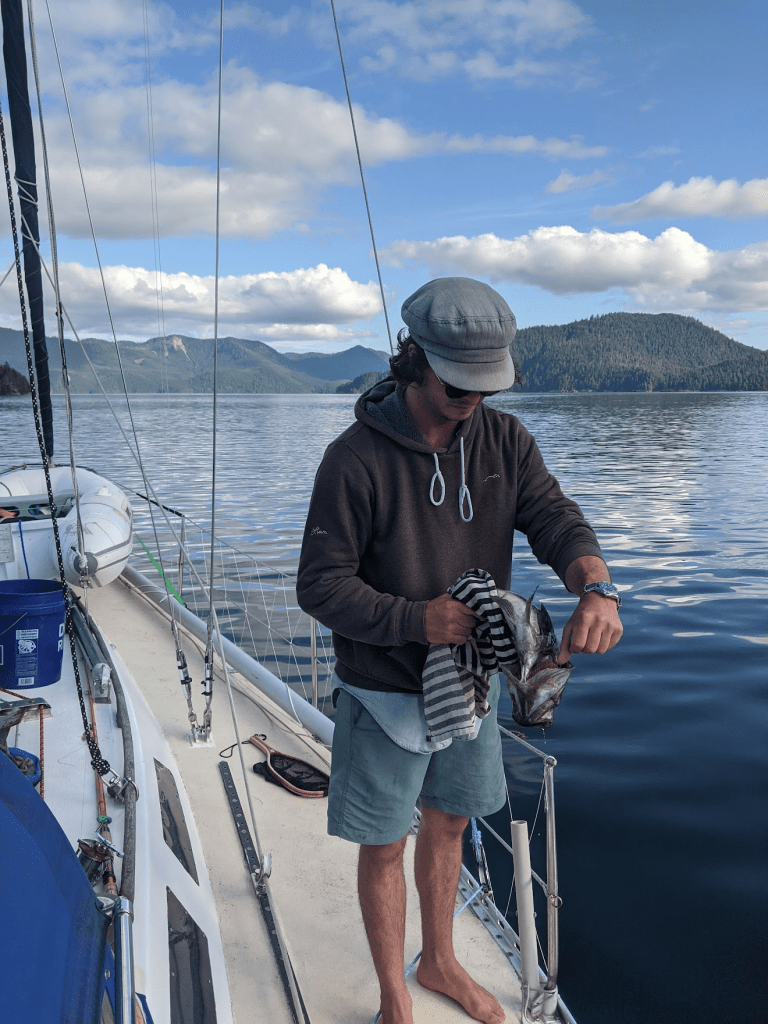
En route to Tanu, Liam caught a rockfish! Under sail ~ 1.7 knots. Then Tanu radios & says hey actually I can fit ya in – come anchor. Then the wind dies! we get the fish in and start motoring to Tanu. Chaos but greeted by Grace who ~graciously~ showed us around.
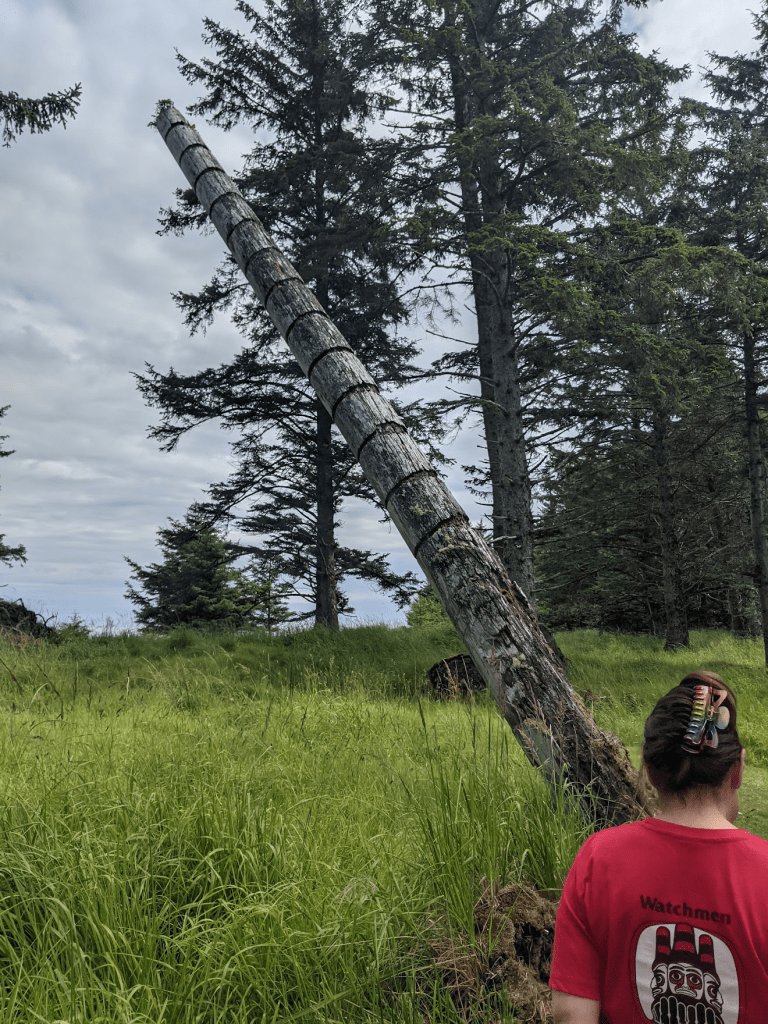
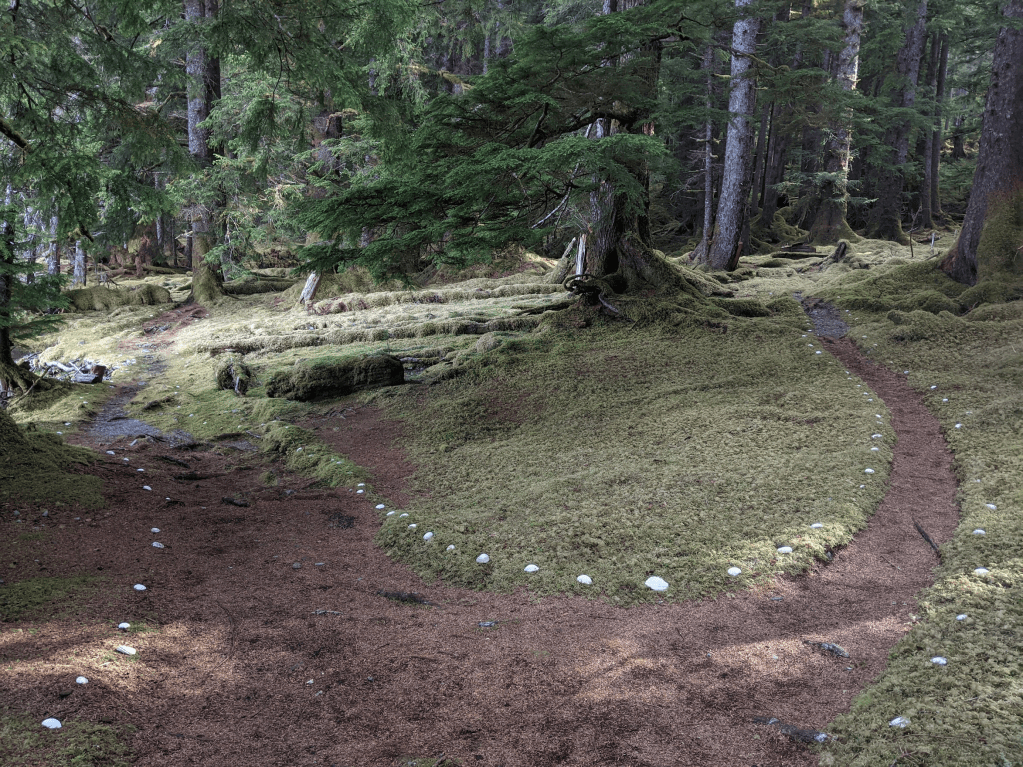
Incredible to see remnants of the longhouses – and even a frontal pole! Some beams still intact in carved out cedar. We saw a beaver manda which is placed outside a house of a family who has lost some one. It stays forever. This one was huge ~ 2 washing machines.
The Chief’s house had 2 doors either side of the frontal pole – unusual. Another had a huge door – almost 5′ tall perhaps. Because of the missionaries, Grace said.
Though, if the village was raided, as was common here to be raided from folks at SG̱ang Gwaay, then this feature unfortunately made the Chief’s house the easiest target. What happens usually is the door is much smaller so you must enter head first. If you are not welcome, then you, quote, GET BONKED -Xiila. Easy to get in with a big door. Then they’d usually grab the 2 closest people. I think to use as slaves. Xiila was saying that in the houses, especially the big Chief’s house, the slaves slept near the door (I would think it was less warm too).
Many people came, from Bella Bella even, to construct the Chief’s house. Again, if you don’t build it in a day, you must restart.

500 people who came to the Chief’s potlatch post small pox ~150 years back. So not all folks left to the north after that. Oh – Xiila said also that folks in the south went to Skidegate and more northern folks went to Masset after the small pox disease wiped folks out. Starting from the south, it swept up. The missionaries told them that the devil will get you if you don’t convert; folks were getting horribly sick & just collapsing so many a believers were made. Vaccines existed on the 2 reservations Masset & Skidegate so people flocked there. Mad & sad.

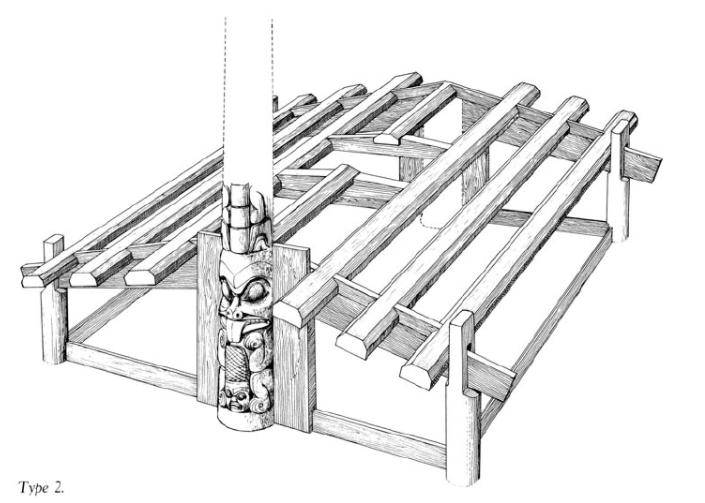
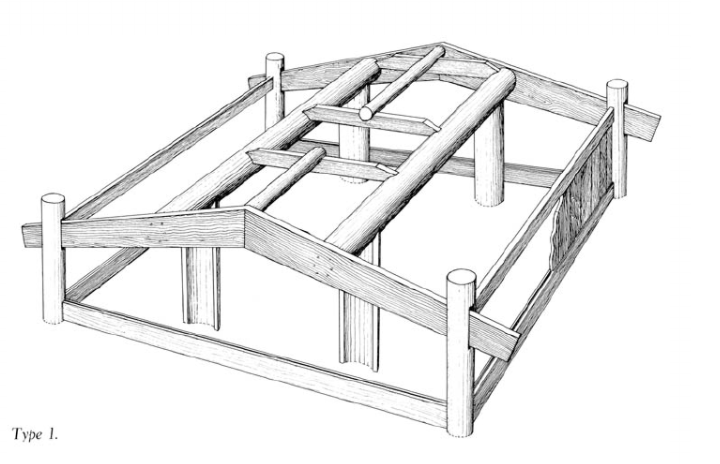
Taken from a great website’s article that cited the following:
Haida Longhouses, Type 1. Credit: George F. MacDonald, A Monumental Art: Villages of the Queen Charlotte Islands (Vancouver: UBC Press, 1983), 19.
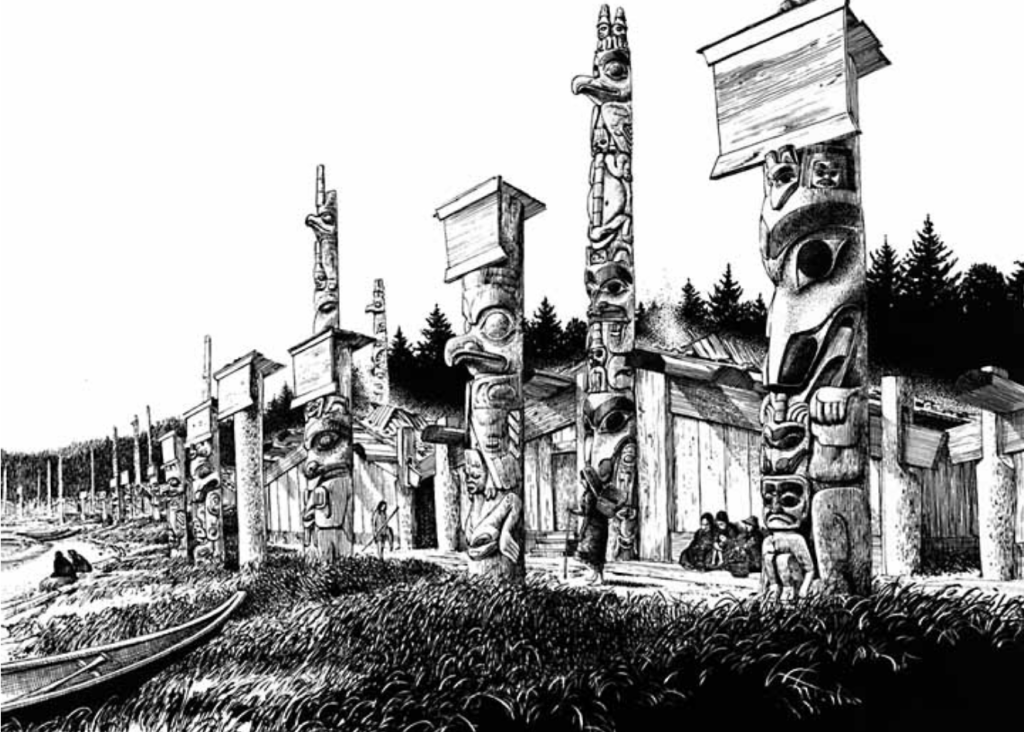
The same neat website that had the longhouse sketches shows images of re imagined longhouses seen below with frontal poles which indicate the residing family’s crest. People moved around so the frontal crests acted to inform visitors which house to go to first upon arrival. If your clan is frog, and you see a frog on a home’s frontal pole, you go there upon arrival to initiate your business or reason for the trip.
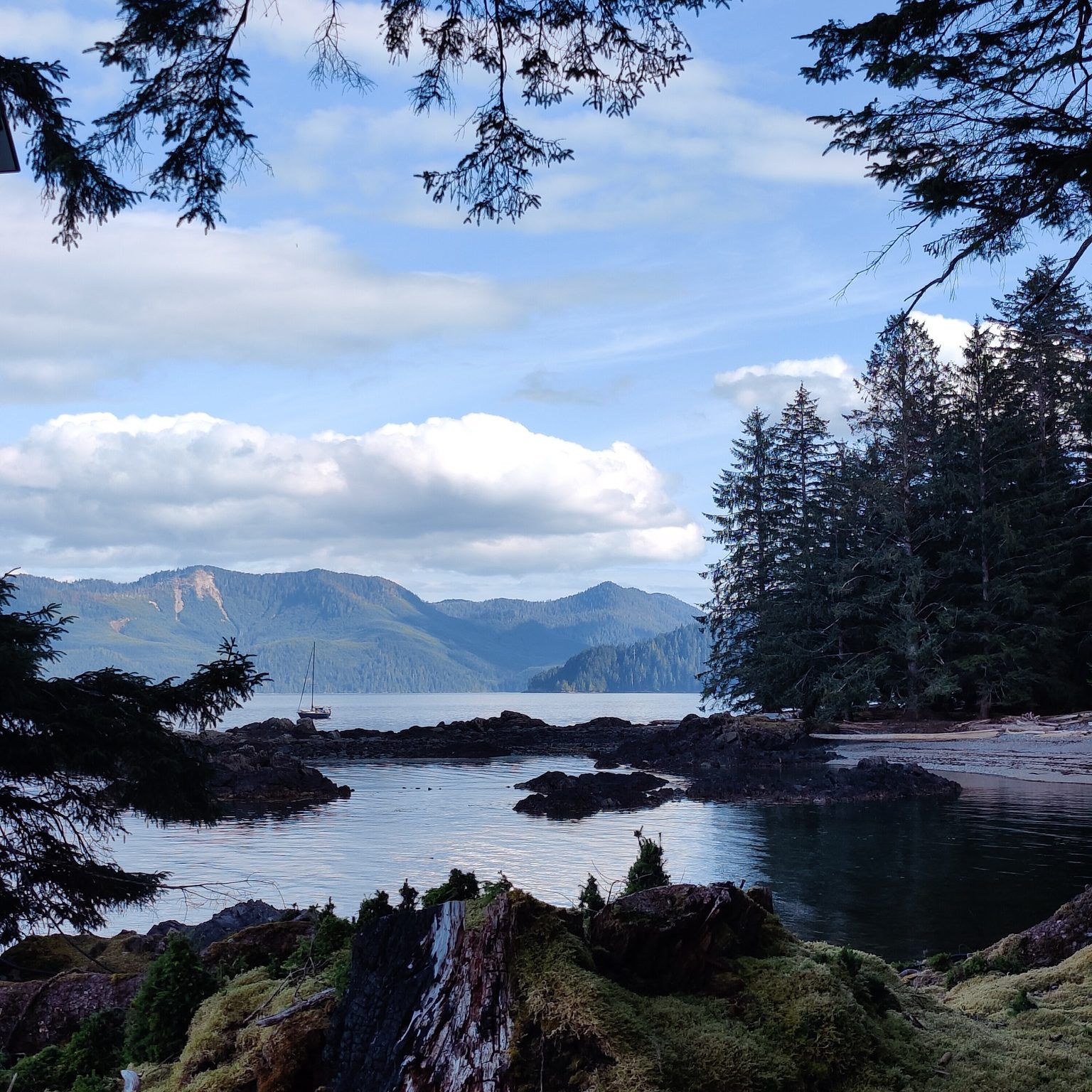
Grace taught us so much! Being the only two, this ~ tour ~ was shorter than at our time in K’uuna. The longhouse remnants were more visible than K’uuna and really showcased the immense amount of work required – IN ONE DAY – to dig out the recessed floor. We poked around the charts for an anchorage, finding a bay with decent depths and protection from the forecast winds (via radio) not too far away.
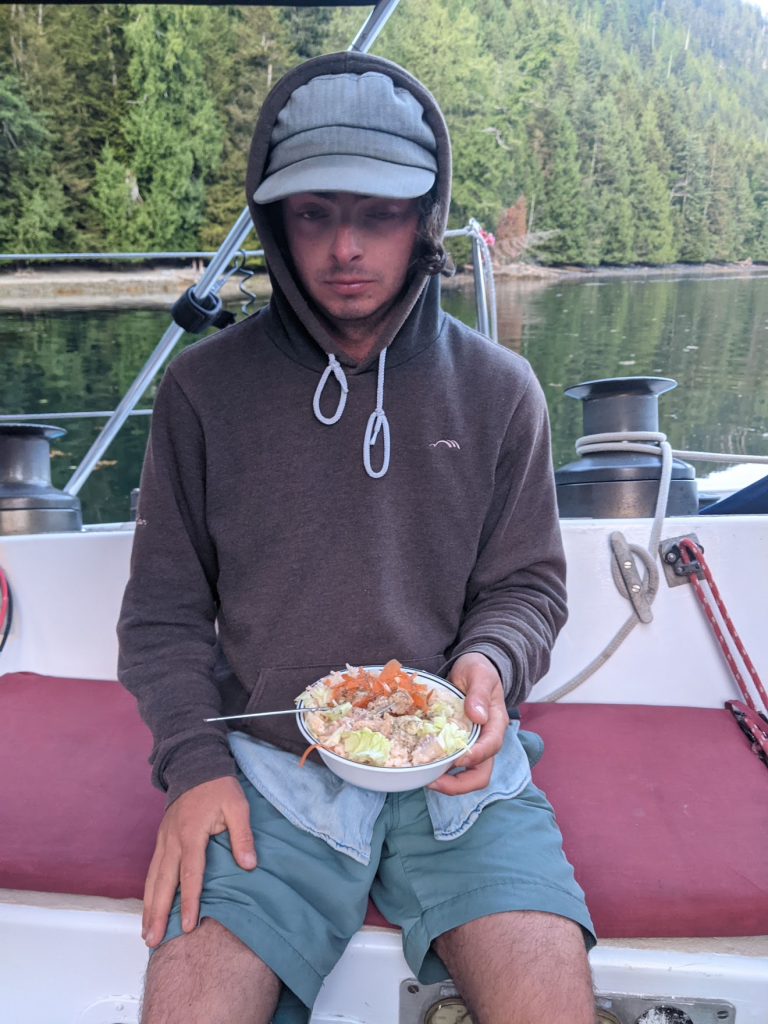
Liam is preparing the fish for poke bowls for tonight – a success! Enjoyed the evening sailing, tacking west then north. Chatting in the cockpit until dark. Read 2 bed.
 Sailing Vessel Karma
Leave a comment